Tag Archives: philosophy

How The Enlightenment Ends

Yesterday (18 May) I read a thought provoking article by Henry Kissinger on the subject of artificial intelligence or AI. The gist of Kissinger’s article is that the enlightenment liberated humanity while we are in danger (by relying on AI) of becoming slaves to the emerging technology and loosing our ability to think critically. The below quote from Kissinger’s article strikes me as containing much wisdom, particularly his point about many technophiles taking refuge from solitude in technology:

“Users of the internet emphasize retrieving and manipulating information over contextualizing or conceptualizing its meaning. They rarely interrogate history or philosophy; as a rule, they demand information relevant to their immediate practical needs. In the process, search-engine algorithms acquire the capacity to predict the preferences of individual clients, enabling the algorithms to personalize results and make them available to other parties for political or commercial purposes. Truth becomes relative. Information threatens to overwhelm wisdom.

Inundated via social media with the opinions of multitudes, users are diverted from introspection; in truth many technophiles use the internet to avoid the solitude they dread. All of these pressures weaken the fortitude required to develop and sustain convictions that can be implemented only by traveling a lonely road, which is the essence of creativity”.

To read the article please visit https://www.theatlantic.com/magazine/archive/2018/06/henry-kissinger-ai-could-mean-the-end-of-human-history/559124/.
Philosophers Disagree On What It Is To Be Free

Shall I confess?
She wore not a dress
But standard issue jeans.
The scenes
Enacted
Impacted
And she
And me
Played our bit part
In this drama of sin.

No words of love were spoken
And the heart
Was unbroken.
Yet one may still regret
Or not as the case may be.

Philosophers disagree
On what it is to be free.
And I think on she
And me.

There Was A Young Lady Called Mabel

There was a young philosopher called Mabel
Who said “this is a virtual table”.
There was a terrible yell
When her good friend nell
Banged her head on that table …

Schopenhauer

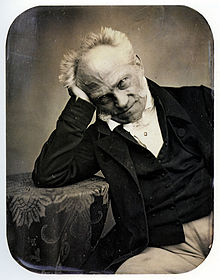
While on the way to the shops yesterday, I met an acquaintance. As one does in such situations, we passed the time of day. During our conversation my companion thanked me for the print copy of my collection of poetry, “My Old Clock I Wind”, that I had given him. He had he said read it 3 times and intended to read it again. My poetry was, in his view bleak and reminded him of Schopenhauer.

I must confess to never having read Shopenhauer, but the words of my acquaintance kindled in me a desire to read up on the philosopher. For anyone interested in learning more about Arthur Schopenhauer I recommend the above article as a good starting point.

As to whether my poetry does, in any sense chime with the ideas expressed by the German philosopher, I feel unable to comment other than to state unequivocally that I repudiate in the strongest possible terms the anti-Semitic views attributed to Shopenhauer.

Anti-semitism is vile and led to the extermination of approximately 6 million Jews (men, women and children). Sadly there remain those on the far-right of politics who continue to propagate the lie that there was no “Final Solution”. Such denials are dangerous and those who propagate them contribute to the curse of anti-semitism.

Kevin

Who is the I in I?

On Tuesday evening (23 May), I had dinner with 2 old friends. During the course of our conversation my friend, Jeff asked “Who is the I in I”? My response was that we are composed of a mix of genetic data inherited from our parents, environmental influences and the culture we absorb from a young age. All of these factors, I said, help to determine who the I in I is.

The snippet of conversation related above, reminded me of my poem “Genes” which is reproduced below:

“Are we just our genes
Means
To a meaningless conclusion,
A confusion of arms, legs and bed?
The head
Is often overruled
By the fool
Lust.
Into eternity we thrust
Desperately hoping to leave one of our kind
Behind
Ere our dalliance ends in dust”.

(“Genes” can be found in my collection of poetry, “Refractions”, which is available, as a Kindle download in the Amazon Kindle store).

The General Will (a satire on the idea that “the people” are invariably right)

Only a fool
Can object to Rousseau’s rule,
For “the general will”
Can do no ill.

It is treason
To deny
That “the people” are guided by reason
And he who does so must die.

So say I
Until “the general will”
Does ill
Unto me
And we are no longer free …

http://www.newworldencyclopedia.org/entry/General_will#Jean-Jacques_Rousseau