Tag Archives: culture

Blast from the past!

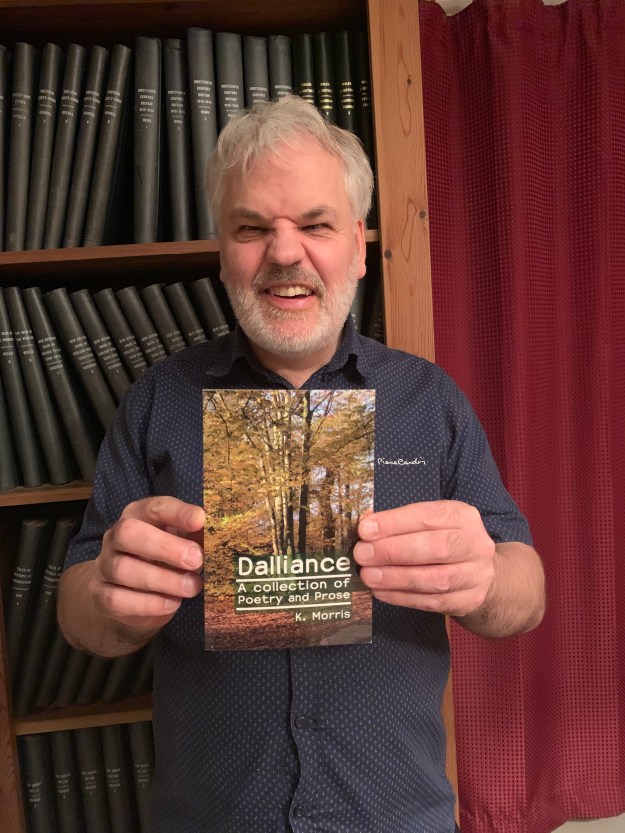
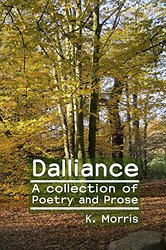
Back in 2015 I released ‘Dalliance; a collection of poetry and prose’ in Kindle and Paperback format. Whilst the Kindle version is still available, the Paperback version (pictured below) is out of print. The Paperback was published by an independent publisher, who have since gone out of business, hence the print book is perhaps, something of a collectors item!

As those of you who follow this blog will know, my ‘Selected Poems’ and ‘The Writer’s Pen’ are available in Kindle and Paperback format. I hope, in the not too distant future, to reissue ‘Dalliance’ in Paperback.

Dalliance is available here for the UK and here for the US.

Dalliance

‘In this world, where nothing really exists, I kiss your cold, dead lips. Meaningless dalliance in this land of the dead, no words spoken: there is nothing to be said. Emotions stifled, frozen in ice, held in deaths stone grip.’


image1 (1)

Celebrate National Poetry Day

Today (3 October) is National Poetry Day here in the United Kingdom. This years theme is truth, although you can write about anything, https://nationalpoetryday.co.uk/celebrate-national-poetry-day/.

To celebrate National Poetry Day I am publishing my poem “Shadows On The Wall”:

“Shadows on the wall,

I recall.

One cannot catch a shade,

For it is made

Of moonbeams

And passing dreams”.

“Shadows On The Wall” can be found in “The Selected Poems of K Morris”, which is available in paperback and Kindle formats here, https://www.amazon.co.uk/dp/B07WW8WXPP/.

If you wish to share a poem you can use the hashtag #NationalPoetryDay.

Is There Any Money In Poetry?

I have been asked by a number of people (including my mum!) whether I make any money from my writing. Yesterday evening, whilst out for a drink with friends, I had the same question addressed to me and answered (so far as my memory serves), in the following manner:

“Very few writers make much money, and its particularly difficult for poets to derive an income from their poetry, as that particular art form is rather a niche market.

Whilst I self-publish on Amazon (which has no costs associated with it), I do pay an editor/proof reader to check for typographical and other errors. Also, whilst there is no obligation on me to purchase author copies, I always do buy paperbacks of my books (albeit at an author discount) to distribute to family, close friends, my local library etc.

I could more easily recoup the cost of the above where it not for the fact that I have been in the habit of giving away copies to strangers, in future I shall become a veritable Scrooge in such matters. Actually, I think that this is unlikely, (me becoming a Scrooge I mean!).

Whilst poets can cover their costs, and even turn a profit, it is extremely difficult for them to do so”.

In light of my conversation with friends yesterday evening, I did a little digging with the help of Mr Google and came across this article, https://www.shmoop.com/careers/poet/salary.html, which does, in essence chime with what I told my 2 friends last night.

I would, as ever be interested in receiving comments from my readers.

Kevin

“The Selected Poems of K Morris” to be featured on Vancouver Co-Op Radio’s The World Poetry Reading Series, at 9:10 pm (UK time), on Thursday 19th September

As previously announced here, https://kmorrispoet.com/2019/09/04/a-date-for-your-diary-poet-kevin-morris-to-appear-on-vancouver-co-op-radios-the-world-poetry-reading-series-at-910-pm-on-thursday-19th-september/, I shall be appearing on Vancouver Co-Op Radio’s The World Poetry Reading Series, at 9:10 pm (UK time), on Thursday 19th September, to discuss (and read from) my recently published “Selected Poems”.

If you would like to listen, but are not able to do so on Thursday evening, it is my understanding that a podcast of my interview will be available following the show. Once the podcast goes live, I shall link to it here.

You can find The World Poetry Reading Series here, http://worldpoetry.ca/.

“The Selected Poems of K Morris” can be found here https://www.amazon.co.uk/dp/B07WW8WXPP/ (for the UK), and here https://www.amazon.com/dp/B07WW8WXPP/ (for the US and elsewhere).

Kevin

I Take Offense!

Recently, I attended an event which began with a choir performing several songs. Later on that same day, I learned that a number of attendees had been offended by the irreligious nature of several of the songs and where minded to complain to the organiser of the event.

The above incident caused me to consider to what extent (if any) I (as a poet) am under an obligation to avoid causing offense. Should I censor my writing and/or performances to avoid upsetting my readers and/or listeners?

I am, by instinct a liberal as regards such matters. If you don’t like a book, a television programme, or a poetry performance then you can stop reading the work in question, turn over to another channel or walk out of the performance.

Having said the above, where young children are present it is, of course wrong to expose them to adult material. I have never known of a poetry performance where it has not been made clear as regards those who will be attending. Of course where a performance is advertised as being suitable for all ages, young children etc, it would be wholly wrong to read poems touching on adult and/or erotic matters. Some of my poems do contain adult themes and I would never dream of performing them at an event at which children where present.

However, I am deeply concerned at the growth of the view that there exists a right not to be offended. Let me qualify the foregoing statement somewhat. Of course we all have a right to be offended. Indeed one can not help finding certain things offensive. What we do not have is the right to use our sense of offense (how ever genuine that may be) to censor artistic expression. Most of us are offended by something or other, whether that be swearing in public or the person standing next to us on the tube who has failed to clean their teeth! However we do, as adults have the capacity to either ignore the offending behaviour or to walk away. To argue that certain songs, literature etc should be prohibited and/or restricted simply because I (or you) don’t like it, is deeply iliberal and ends in a society where poets and other producers of art confine themselves to writing about flowers and sweet little lambs frolicking in the countryside. Whilst there are some wonderful poems and other artistic creations touching on these themes, no artist should be compelled (or feel so compelled) either by the state or the force of public opinion (whether majority or minority opinion) to self-censor. To do so leads to an anodine world in which little (if anything) of artistic value flourishes.

I well remember having a conversation with a person of deep faith in which they stated that no one should be allowed to criticise their religion and, in particular their god. I find this perspective deeply disturbing. We do, thankfully live in a liberal society wher you and I have a right to be offended. However we have no right to use that offense (however deeply felt) to call for the censoring of the opinions of others, whether in the field of art, politics or in any other sphere.

I’m offering a free Paperback copy of my book!

To be in with a chance of winning a free signed copy of my recently released book ‘The Selected Poems of K Morris’, please answer the following question:
Who composed ‘The Ballad of Reading Gaol’?

The rules:
1. Only one copy of my selected poems is available.
2. The first person to provide the correct answer wins a free copy of my book.
3. The competition is open to readers worldwide!
4. Please do not leave the answer in the comments section below this post (as other people will be able to read your answer!). Please send your answers to kmorris poet (at) gmail dot com (the address is given in this manner to avoid spam).
5. The competition closes on the 30th September, at 12pm UK time. Entries received after this date will not be considered.

You can find my selected poems here for the UK and here for the US.

To read a recent review of my book please visit here.

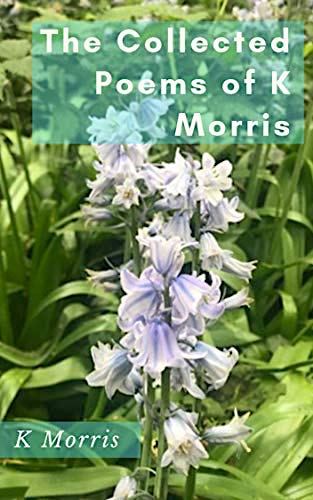
This book encompasses poems composed between 2013-19. The poems included here have been selected from ‘Lost in the Labyrinth of my Mind’, ‘My Old Clock I Wind and other poems’, ‘The Writer’s Pen and other poems’, ‘Dalliance; a collection of poetry and prose’, ‘Refractions’, and ‘The Girl who Wasn’t There’. In addition a number of previously unpublished poems are included in this book.The poems range from those dealing with nature to others, which touch on the passage of time and mortality.

Do Poets Attempt To “Control” People?

On my way home yesterday evening, I bumped into an acquaintence and engaged in one of those random and somewhat odd conversations one does, on occasions find oneself involved in. My acquaintence with the gentleman with whom I spoke is of a passing nature, in that we have spent a few minutes chatting when we encounter one another. However, yesterday evening we spent some 40 minutes or so talking, during the course of which I learned that he is an artist. This led me to mention that I write poetry, to which his response was that “poets/poetry wants to control people”.

I was, I must confess somewhat taken back by the above statement. Despite me trying to elicit why my acquaintence held such a view, I was unable to obtain an answer which made sense to me. However the statement that “poets/poetry tries to control people” got me thinking about whether there might be any substance to the opinion expressed by my acquaintence.

Poets do (as with the rest of the population) hold views on religion, politics etc, some of which find their way into the poetry they write. Can reading a poem which voices a particular opinion “control” the reader?

Many years ago I remember reading an anthology compiled by the late left-wing Labour politician Tony Benn, entitled “Writings On the Wall: A Radical and Socialist Anthology”. I remember being impressed by some of the writings contained therein, however the book did not turn me into a Socialist. Where there to be a simple connection between what we read and how we vote then, surely I would now be a card carrying member of the British Labour Party or another Socialist party which (as mentioned above) I am not.

A poem has no power to exert physical control over the reader. Indeed, during the course of our chat, I mentioned to my acquaintence that where I to take hold of him and demand that he act in a certain manner that this would, quite obviously entail an attempt by me to exert control over him (I hasten to add that no one was grabbed or maltreated in any manner during the course of our interactions). We can, therefore safely conclude that poetry (or any other form of art for that matter) has no power to (literally) “control anyone.

Having said the above, it is true that Nazi Germany, the former Soviet Union, Mao’s China and various other regimes have banned books and persecuted (or even murdered) writers with who’s work they disagree. For example “The Gulag Archipelago”, which catalogued the horrors of the Soviet prison system was banned in the USSR, and its author persecuted. So, obviously totalitarian governments fear literature that attacks the belief structure on which the regime is built.

Does the fear of totalitarian regimes of literature which attacks their world view proove that poetry (and other forms of art) have the power to “control” those exposed to them. No. What free artistic expression can accomplish is to encourage those exposed to it to question their view of the world (or at least some aspect of it). Encouraging critical thinking is not control. Quite the opposite for, in the case of the authoritarian government it is the regime (not the poet or other artist) who is “controlling”, whilst the artist is questioning the status quo.

In conclusion, poetry does not “control”. It may (and often does) contain a message (political, religious or otherwise), however the reader can make up his/her own mind as to whether they agree (or disagree) with the poet’s perspective. It should, of course also be remembered that much poetry is purely (or largely) playful in nature. There is, for instance in most limericks no desire on the part of the poet other than to produce laughter in his/her readership.

As always I would be interested in the perspectives of you, my readers.

Kevin
Simon Armitage is appointed as the UK’s new Poet Laureate

Simon Armitage has been appointed as the UK’s new Poet Laureate, replacing the former holder of that position, Carol Ann Duffy. The Daily Telegraph has an interesting article on the appointment which can be found here, https://www.telegraph.co.uk/news/2019/05/10/xxx/