There was a young man called Matt
Who said “poetry is old hat”.
His brother Jim
Disagreed with him.
It ended in a spat!
There Was A Young Man Called Matt
3 Replies

There was a young man called Matt
Who said “poetry is old hat”.
His brother Jim
Disagreed with him.
It ended in a spat!
This is an extremely good cause. I have happy memories of being read to by my grandfather. I particularly remember The Famous 5, The Secret 7 and many fairytales. I wish this project the very best of luck. Kevin
I would like to reach out to kid lit authors and book bloggers to get quality books into the hands of deserving kids.
Throughout the month of March, I am collecting new children’s books to benefit children of incarcerated parents. Authors, I hope you will consider donating signed copies of your books. Book bloggers, please help us by sharing this information with your readers.
I am a children’s author, teacher, and mom who is passionate about children’s literacy and the power of children’s books. When I learned nearly 2/3 of children, living in poverty, DO NOT own books, I was moved to act. I founded the literacy initiative, Picture Book Pass it On, to raise awareness for literacy issues and get books to kids in need.
Three years ago, the Picture Book Pass it On initiative grew to include a month-long book drive called MARCHing Books to Kids.
View original post 424 more words
Would
That I could
Find Chrysanthemums in bud.
For those in bloom
Are gone to soon.
I remember the sweet scent
Of the chrysanthemums that bloomed
In my grandfather’s garden.
Entombed,
They are long since spent.
I expressed a view, contrary to your own.
Now I am alone
Thinking on the old adage that one ought
Not to talk,
About religion, politics and sport.
Ah, daffodils
That do banish all ills,
By performing a spritely dance.
Oh the romance
Of it all,
But then the rain did fall.
The flowers where beaten down
And the earth did drown
In a deluge most foul
Which made the poet scowl!
My dog did howl
For in my haste
To taste
Nature’s beauty
I forgot his towel
And my duty
To keep both him and I
Dry!
Oh blasted daffodils
And rain soaked hills!
I need my pills
For I feel chills
That will lay me low
So to the good doctor I must go!
Hey ho
I will romanticise it all
For I recall
How my public do adore
Poems about nature’s beauteous store!
“The daffodils are out in Saint James’s Park”
My colleague did remark.
Today
The wind blusters
Through Wordsworth’s spritely clusters,
And I wonder how long will the chancers stay.
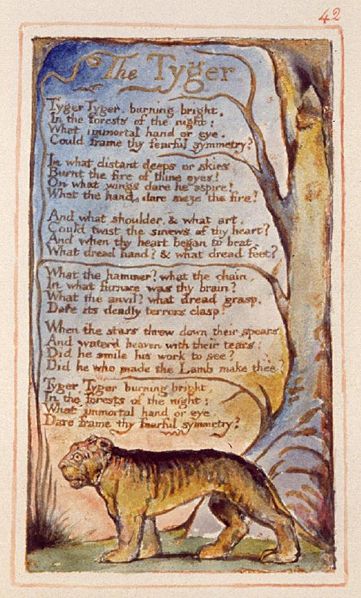
A critical reading of an iconic poem
‘The Tyger’ is arguably the most famous poem written by William Blake (1757-1827); it’s difficult to say which is more well-known, ‘The Tyger’ or the poem commonly known as ‘Jerusalem’. The poem’s opening line, ‘Tyger Tyger, burning bright’ is among the most famous opening lines in English poetry (it’s sometimes modernised as ‘Tiger, Tiger, burning bright’). Below is this iconic poem, followed by a brief analysis of the poem’s language, imagery, and meaning.
Tyger Tyger, burning bright,
In the forests of the night;
What immortal hand or eye,
Could frame thy fearful symmetry?
In what distant deeps or skies.
Burnt the fire of thine eyes?
On what wings dare he aspire?
What the hand, dare seize the fire?
View original post 767 more words
When I taught college writing, I told students to write like they talk.
I didn’t mean write like you really talk.
If we taped and transcribed our conversations, we’d quit reading after the first page. In everyday conversation we use filler language to give our brains precious seconds to catch up with our words, we backtrack to fill in details we previously forgot.
From time to time we expel word farts.
For example:
“Like, Carol and I were driving, you know what I mean? When this badass cop, I mean really badass, six foot tall in navy blue, nazi jackboots, you could tell he wanted to bust anyone to put another notch in his badge. Where was I? Oh, yeh, he pulls us over, we were driving seventy, like, I mean…we were in Dripping Springs which is about twenty miles south of Oak Hill, if you’ve never been out that way? No shitting? Man, I thought everyone knew about Oak Hill even if they never drove through. But anyway, the only other drivers are rednecks and blue haired ladies, I kid you not…”
I use the phrase “Write like you talk” as a metaphor for stripping the pretension from your writing, writing to communicate rather than impress. In non-fiction that means make sure to make your point clear. In fiction that means no distractions; keep the reader in the story.
“Write like you talk” doesn’t mean leave no room for art, tropes, themes and metaphor. In fact, writing without artistry can turn away readers as quickly as murky prose. It means that you shouldn’t front-load your prose to impress readers with your artistry, but to enhance the story. If it distracts the reader, if it draws attention to you and away from the story, then you might as well write poetry.
However, even should you turn to poetry, the best poets would advise you that art should never distract the reader from the poem. The only time you want the reader to dwell on the trope is when she reaches the last line, the image lingers in the corners of her consciousness and she thinks, “Wow.”
The artistry in your story should be like that. It should linger at the back of the reader’s consciousness. They might not even recognize it until another reader points it out. Readers want to ride in the passenger seat at full speed until you dump them at the destination. Ride over. Their response should be. “Ride over? No way. Let me back in the car.”
Crafting a good story requires walking a fine balance between clarity and artistry. Hopefully the adage, “write like you talk,” will remind you that every story should carry a quality of ordinary conversation.
Compare the writing of Pynchon and Joyce to Hemingway and William Carlos Williams. Which impresses and which do you follow without wrestling with meaning?
You don’t want your readers (especially when you write non-fiction) to think, “He was a brilliant writer. I didn’t understand a word he said.”
Twitter: @stephenspt
Cigerets, Guns & Beer: Kindle, paperback
Seeing Jesus: Kindle, paperback
Raising Hell: Kindle, paperback
The Worst Noel: Kindle, paperback
“The Hellelujah Trail,” free on Smashwords
“A Christmas Carol: The Sequel,” Smorgasbord—Variety is The Spice of Life
“Quantum Noir” Wind Eggs
“Free Wheeling Free Association and the Theme Park Rangers of Death,” Hell’s Grannies: Kickass Tales of the Crone
“Hell’s Kitties,” Hell’s Kitties: and Other Beastly Beasts
The Poetry That Drives and Divides Faith International Journal of Religion and Spirituality in Society (1:43)
”Science and the Language Wars,” International Journal of Religion and Spirituality in Society(2:4)

There was a young leader called Lee
Who shouted “all you people follow me!”.
He ran straight ahead,
Then stopped dead,
On account of hitting a tree!
Thank you to Pax Et Dolor Magazine for publishing my poem “Ere We Die”.
By :- Kevin Morris
On seeing the stormy sky
The poet thinks “man must die”.
He sees the young girl bloom
And says “she is destined for the tomb”.
Oh let us gather wild flowers
And not waste our powers
Trapped in ivory towers.
Beware the scholar’s domed head
For we are soon dead.
May our spirit fly
Ere we die
And are lost in endless sky.
The copyrights on the article belong to the author. The responsibility for the opinions expressed in the article belongs exclusively to the author. Find more of his beautiful works at newauthoronline
The poem appears in his
collection of poetry, “Lost in the Labyrinth of My Mind“


