A good and interesting article in the Spectator, entitled Let Children Learn our Best Verse, Let children learn our best verse | The Spectator
A good and interesting article in the Spectator, entitled Let Children Learn our Best Verse, Let children learn our best verse | The Spectator
The sunlight falls
On Whitehall’s walls.
Some regret the sunset.
But all fires die.
And I delight
In morning light
And Kipling who foresaw
Empire might not endure
The passing chimes
Of Westminster Cathedral bring to mind
A former time
When belief in empire still burned strong.
Yet in his song
Rudyard Kipling foresaw
That the fire
Of the British Empire
Would burn no more.
Westminster Cathedral’s chimes
Will continue on
When I am gone
And Kipling’s great rhymes
Will be condemned
(As before)
By men
Who have never read
“Recessional”. and know not he foresaw
That the red
Of empire would show no more.

A close up of Trigger!
I have lost my dear old friend Trigger. My guide dog who brought so much joy into my life (and that of others), and who served me faithfully as my guide from 4 July 2011.
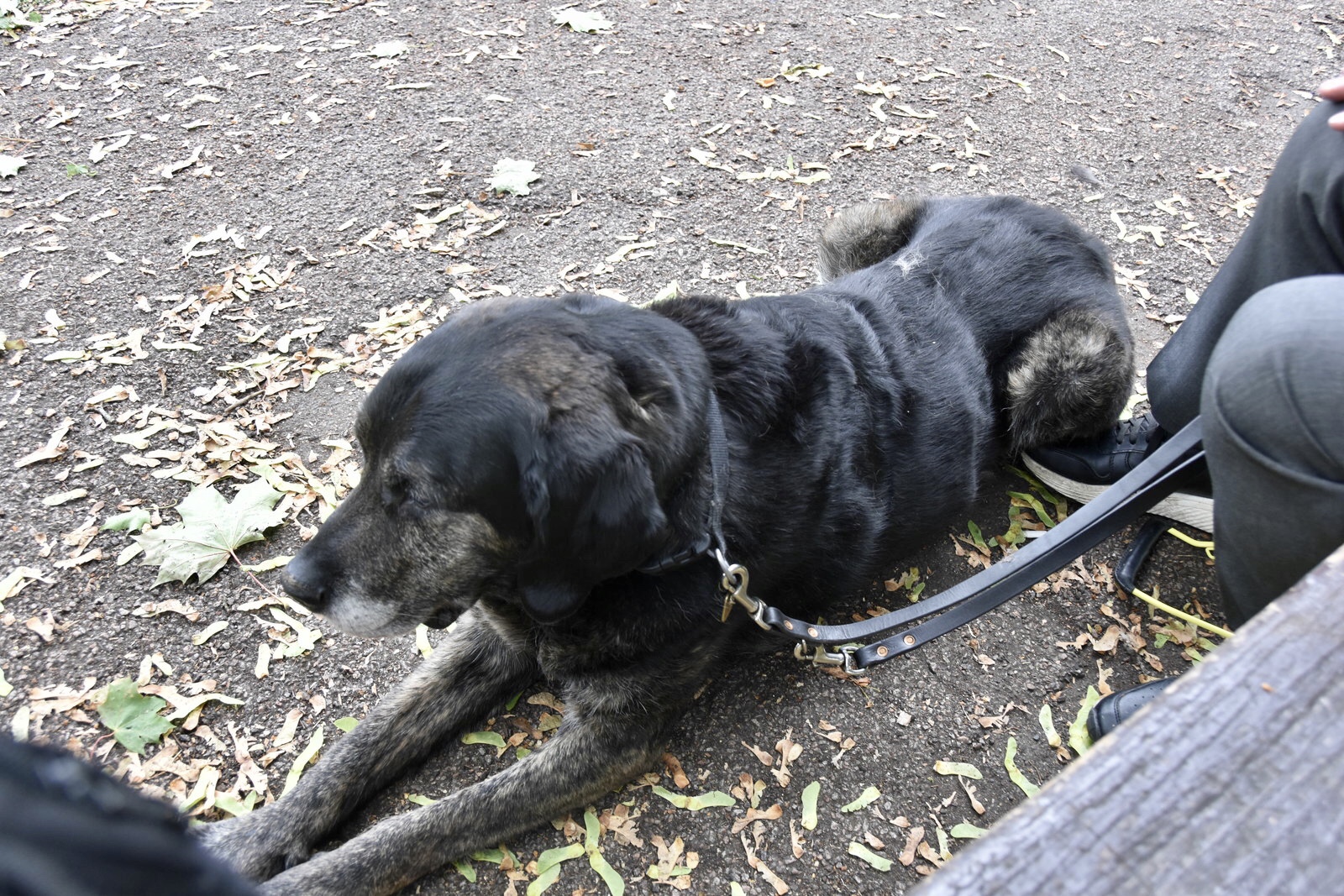
Trigger relaxing on the ground
Trigger became very unwell on the evening of Saturday 29 July. My mum, sister and I rushed him to the vets. Although Trigger received excellent treatment his condition deteriated. There was no chance of recovery and to avoid unnecessary suffering I took the heart breaking decision to have my dear old friend euthanised yesterday (Tuesday 1 September).
My mum and I spent some 20 minutes or so with Trigger prior to him being sent into that sleep from which none of us return. He circled us with a pilow case in his mouth, his tail wagging and died, peacefully with that same case in his mouth.
I have so often seen Trigger greet me and family and friends with his blanket or some other object in his mouth, his tail waving wildly.
He has left a huge hole in my life. But he died as he lived, happy with a pillow case clamped in his jaws, surrounded by people he loved, and people who loved him.

Trigger in his bed
The below poem, “The Power of The Dog”, by Rudyard Kipling sums up how I feel and, doubtless how countless other dog owners feel (and have felt) on losing a faithful friend:
“There is sorrow enough in the natural way
From men and women to fill our day;
And when we are certain of sorrow in store,
Why do we always arrange for more?
Brothers and Sisters, I bid you beware
Of giving your heart to a dog to tear.
Buy a pup and your money will buy
Love unflinching that cannot lie—
Perfect passion and worship fed
By a kick in the ribs or a pat on the head.
Nevertheless it is hardly fair
To risk your heart for a dog to tear.
When the fourteen years which Nature permits
Are closing in asthma, or tumour, or fits,
And the vet’s unspoken prescription runs
To lethal chambers or loaded guns,
Then you will find—it’s your own affair—
But… you’ve given your heart to a dog to tear.
When the body that lived at your single will,
With its whimper of welcome, is stilled (how still!).
When the spirit that answered your every mood
Is gone—wherever it goes—for good,
You will discover how much you care,
And will give your heart to a dog to tear.
We’ve sorrow enough in the natural way,
When it comes to burying Christian clay.
Our loves are not given, but only lent,
At compound interest of cent per cent.
Though it is not always the case, I believe,
That the longer we’ve kept ’em, the more do we grieve:
For, when debts are payable, right or wrong,
A short-time loan is as bad as a long—
So why in—Heaven (before we are there)
Should we give our hearts to a dog to tear?”.
(The above poem is in the public domain).
Below are some photographs of Trigger taken several weeks ago, by my friend Jeff, in a park close to my home.
Trigger relaxing on the ground

My friend Trigger and me at the Park

Me petting Trigger

Me talking about Trigger

Me remembering Trigger
At school, I read freely
Of Kipling’s poetry.
No one told me
What my thought ought
To be.
Today there is an urge
To purge
His poetry.
Yet, in “Recessional”, we see
The fire of empire die.
They hector
And lecture.
While I,
And those like me,
Retreat into our poetry.
In “10 of the best political poems everyone should read”, the site Interesting Literature lists (amongst others) W. H. Auden’s “September 1st, 1939” and Rudyard Kipling’s fine poem “Recessional”. The latter poem is no mere glorification of British imperial might. The words “lest we forget” and Kipling’s references to long gone empires, and those “drunk on power” demonstrates that the poet recognises that empires and civilisations pass. We should not be arrogant but must maintain a “humble” and “contrite” heart.
You can read Interesting Literature’s post here, https://interestingliterature.com/2020/06/political-poems/.
I have written a number of poems touching on the subject of politics, including the below poem, which is entitled “When the Squire, Sitting By His Fire”:
When the squire
Sitting by his fire,
Rang the bell,
Who can tell
Whether the servant, summoned by his call
Had any desire
For the great hall to fall.
How easy ’tis to condemn
Past men.
But tell me
would you reject
The established imperfect
For a future that may never be?
(The above Poem can be found in my collection “Light and Shade”, which is available here
https://www.amazon.com/Light-Shade-serious-not-poems/dp/B08B37VVKV.
A couple of weeks ago, I fell into conversation with a librarian. During the course of our conversation she mentioned that the library does not stock books which their readers might “find offensive”. This exchange got me thinking about how one defines what constitutes “offensive”, and whether something being so classified is a sufficient reason for not allowing it on to the library’s shelves.
The great English author and poet, Rudyard Kipling is loved by people of every race and creed. Yet a number of his writings would, in today’s society be considered “offensive” by many. Take, for instance his poem “The Stranger” which begins thus:
“The Stranger within my gate,
He may be true or kind,
But he does not talk my talk –
I can not feel his mind.
I see the face and the eyes and the mouth,
But not the soul behind.
The men of my own stock
They may do ill or well,
But they tell the lies I am wonted to,
They are used to the lies I tell.
And we do not need interpreters
When we go to buy and sell”. (http://www.kiplingsociety.co.uk/poems_stranger.htm”.
The message of “The Stranger” is, in effect that people of different races should not mix (I.E. the black should stick to the black, the Asian to the Asian and the white to the white”. This is not a view I share and I can understand why many people find Kipling’s sentiments highly offensive.
“The Stranger” can be found in any complete collection of Kipling’s poems. Given that most people (including me) find the sentiments expressed in the poem offensive, should libraries not stock complete collections of Kipling’s works on the grounds that readers may be offended by them?
To answer the above question we need to stand back and look at “The Stranger” from the perspective of the time of it’s composition. The poem was written in 1908, at a time when many Englishmen (of all political persuasions) held views which we would, today regard as racist. Kipling believed that Britain had a duty to look after what he (in “The White man’s Burden” terms as “lesser breeds without the law”. This was not (as with the Nazis), a belief that those with white skin had the right to enslave or exterminate those of darker skin. Rather it was a paternalistic (and to us today) patronising view. It was not, however an uncommon opinion (as stated above) and was (as previously mentioned), widely held by Europeans at that time.
To banish “The Stranger” from library shelves would be a deeply illiberal act. Educated adults can employ their judgement and understand the historical context in which “The Stranger” was written and (without in any way justifying the message of the poem) appreciate the musicality of “The Stranger”.
One of the problems with defining what is offensive, is that what I may find offensive my friend Jo Bloggs may find perfectly acceptable. For example some religious people wish to see books which (in their words) “promote homosexuality” banished from libraries. They regard gay sex as immoral and believe that those who engage in it (or, via books, the media etc “promote”) it are ungodly. This is not a view I share, however those holding it are entitled to do so. What they are not entitled to do is to foist their opinions on others. If you don’t approve of a particular book, don’t read it, but don’t dictate to others what they can and can not read.
In conclusion, adults should be treated as such and not as children who need to be protected from reading something which may “deprave”, “offend” or “corrupt” them. Its perfectly possible that some of the views which are, today mainstream may, in the future be considered as “offensive”. I trust that, if this does transpire, that the librarians of the future will treat adults, as adults and not as children.
I would, of course be interested to hear your views and, in particular those of any librarians who may read this post.
Kevin
This poem first appeared here on 9 April 2017:
In the restaurant its just the waiter and I,
While outside the window Vehicles speed by.
“There are a lot of beautiful women outside today”,
He remarks by way
Of conversation.
I drink
My wine and think
About this nation
On who’s empire the sun would never set.
Kipling may regret,
Yet
The sun continues to shine
And there is curry and wine,
While in the street
Multiracial feet
Hurry
Along,
Beating out a more or less harmonious song.
THE smoke upon your altar dies,
The flowers decay.
The Goddess of your sacrifice
Has flown away.
What profit then to sing or slay
The sacrifice from day to day ?
“We know the shrine is void,” they said,
“The Goddess flown –
“Yet wreaths are on the altar laid –
“The Altar-Stone
“Is black with fumes of sacrifice,
“Albeit She has fled our eyes.
“For, it may be, if still we sing
“And tend the shrine,
“Some deity on wandering wing
“May there incline;
“And finding all in order meet,
“Stay while we worship at her feet. ”
IT IS always a temptation to an armed and agile nation
To call upon a neighbour and to say: –
“We invaded you last night – we are quite prepared to fight,
Unless you pay us cash to go away.”
And that is called asking for Dane-geld,
And the people who ask it explain
That you’ve only to pay ’em the Dane-geld
And then you’ll get rid of the Dane!
It is always a temptation for a rich and lazy nation,
To puff and look important and to say: –
“Though we know we should defeat you,
we have not the time to meet you.
We will therefore pay you cash to go away.”
And that is called paying the Dane-geld;
But we’ve proved it again and again,
That if once you have paid him the Dane-geld
You never get rid of the Dane.
It is wrong to put temptation in the path of any nation,
For fear they should succumb and go astray;
So when you are requested to pay up or be molested,
You will find it better policy to say: —
“We never pay any-one Dane-geld,
No matter how trifling the cost;
For the end of that game is oppression and shame,
And the nation that plays it is lost!”
—
 K Morris - Poet