Tag Archives: reading

Who is worse, the tempter or the sinner?

Who is worse? The tempter or the sinner?
The expensive dinner
Bought by a man, for a girl young enough to be his daughter.
Common sense flung
Aside,
Along with his pride.
As a lamb to the slaughter
He traverses a path
That would make a cat laugh.

And what of the girl, who does strive
To keep alive?
(Though in the west,
One must confess
That it is more likely to be her “need”
For a new dress
That does her greed
Drive).

The tomb is ever near.
Perhaps it is this thought most drear
That leads a man, in later life,
To take to mistress or wife
A girl who will still
The fear that he is growing old
Though the charms
Of youthful arms, bought with gold
Can not a man save
from the cold grave.

Poet Kevin Morris interviewed for Rhyme

I was honoured to be interviewed by Victoria, for her excellent site Rhyme. My interview covers a variety of topics, including what inspires me to write poetry, together with those poets who have exerted an influence on my writing. To read the interview please visit https://rhymepoetry.wordpress.com/2017/06/01/interview-with-kevin-morris/.

Birds of Diverse Feather

“At least he wasn’t rough” she thinks,
And drinks
To forget
Her regret.

In the evening drear,
He recollects a timid deer.
Swallow after swallow of beer
Fails to hide
The hollowness inside.

“Never again”
The girl says,
But when he calls
She falls
For he who pays often finds
That money binds together ,
Birds of diverse feather.

Your Assistance In Choosing A Book Cover (Follow-up Post)

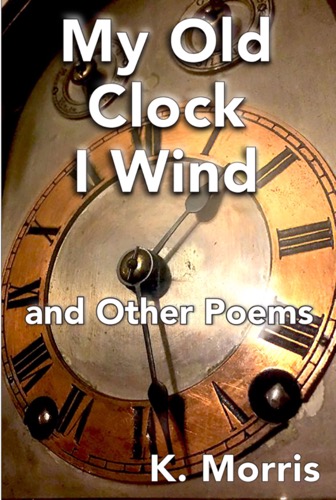
On 11 April, I published a post in which I asked for your assistance in choosing an image, for the book cover which will adorn my forthcoming collection of poetry, “My Old Clock I Wind and Other Poems”. Many thanks to everyone who took the time to comment on the photographs, your input is very much appreciated.

Having considered all your comments, I have decided to use the below image, which shows the clock in it’s entirety. Several of those who commented mentioned the glare in the original image, while others recommended that the title of my book be made more prominent.

I would welcome your views regarding the reworked photograph. Has the glare been sufficiently dealt with? Does the title now stand out sufficiently? Once again, many thanks for your help.

Kevin

A review of “My Old Clock I Wind and Other Poems”

I was pleased to receive the below review of my forthcoming collection of poetry, “My Old Clock I Wind and Other Poems”. Please note, the reviewer received a free electronic copy of “My Old Clock I Wind” in exchange for an honest review. I am grateful to JC for taking the time to read and review my book.

—

“From the very first poem, My Old Clock I Wind, the subject of this volume of poetry is known… we can stop the hands of a clock but not the hands of time.
And if there were a soundtrack to this book of poetry, it would be George Harrison’s, All Things Must Pass.

Every time I review one of Kevin’s books I am struck by the way he can take a subject matter and make it sound fresh to each poem, not one poem ever feels
like it is just filler material, each can stand on its own.

Although the main theme is of time marching on to an unknown destination, death, and decay, we must question that destination and fully embrace it if we
want to start living life to the fullest. These themes are interwoven in poems about the seasons, ecology, social media, the modern world versus the past.
A few of my favorite are Count Dracula Went Out to Dine, Feather, Twenty Seventeen, and Graveyard.

A notable mention is Daffodils; one would think there has been enough poetry about this flower but Kevin manages to place it in a new refreshing situation.
In another poem, we are invited for an Evening Walk along with Kevin’s guide dog, Trigger to Hampton Court.

I think this is a handsome volume of poetry and would make a good companion on any day no matter the weather”.
(JC’s website – https://nimbus432.wordpress.com/).

Is there any benefit in studying creative writing?

Let me be blunt (a thing foreign to my character)! I do not believe that one can learn to be a writer by studying creative writing or by participating in creative writing events. I must, in fairness caveat the forgoing statement by making it clear that I have no background in creative writing (I neither studied the subject nor have I taken part in creative writing groups so, on this basis some may decide to take my opinion with a very large pinch of salt).

So what is my objection to creative writing courses and/or creative writing groups? I have no beef with like-minded people who wish to meet together either online or in the real world to discuss writing and bounce ideas off one another. I am sure such discussions can be highly stimulating and I know of people who have greatly enjoyed participating in them. No doubt ideas spawned in creative writing discussions have led to the composition of great literature. However observing a country scene, a conversation with a friend and many other experiences can (and have) led to the production of great art (I.E. there is, in my view nothing uniquely special about the creative writing process (by which I mean that which occurs in academic institutions)that ought to cause us to accord it particular privilege.

I stand to be corrected but, to my knowledge very few (if any) of the literary greats studied creative writing. Dickens, Tolstoy, Shakespeare and Blake (to name but a few) certainly did not. They perfected their craft through hard slog, trial and error which is, in my experience how the vast majority of writers improve their writing craft.

There are, in this world a multiplicity of individuals and organisations who promise (usually, but not always for financial recompense) to make us more beautiful, richer or yes (you guessed it) great writers. Some of these people do, no doubt mean well and are convinced that they can teach the art of writing. Perhaps, in some instances they kindle within the budding writer that spark which leds on to the production of a literary masterpiece. Perhaps? perhaps Not?

In conclusion, one can not (in my view) learn to write by studying creative writing. One perfects the ability to write by hard slog and burning the midnight oil. Beware of snake oil salesmen who say “sign up to this course” “, “buy my book on creative writing” etc “and you will learn how to write. I welcome comments from anyone irrespective of your point of view. If you have gained from attending a creative writing course do please comment. Likewise, if your experience has been mixed or negative do, please also input.

A review of my forthcoming collection of poetry, “My Old Clock I Wind And Other Poems”

I am grateful to Annette Rochelle Aben, for writing the below honest review of my forthcoming collection of poetry, “My Old Clock I Wind and Other Poems”, in exchange for a free electronic copy of the book:

28 March 2017

My review for “My Old Clock I Wind and Other Poems” by Kevin Morris

If you have yet to find yourself lost in a book of poetry by English poet, Kevin Morris, then lose yourself in My Old Clock I Wind and Other Poems. Allow yourself to wander through the changing seasons, to experience the magic of limericks, and to be entertained by the musings of a man who sees this world through different eyes.

You’ll learn about girls with unsuitable shoes, what having dinner with Dracula might be like and wonder if a garden log might be an alligator or perhaps a crocodile. Be thought provoked, by a magpie and perhaps find yourself shaking your head in agreement with the last line of Kevin’s Melting Ice. “and now the call, of the bird, goes unheard, by those drunk on their own words.”

For Kevin Morris, another notch on the belt of his writing career. For us, the readers, yet another opportunity to experience the world through the poetic eyes of a multi-faceted English poet. My Old Clock I Wind and Other Poems belongs in your collection.

Annette Rochelle Aben


Legal Deposit for Self-Published (And Other) Authors

Yesterday evening, I met up with an old friend (who is also an author) for dinner. Inevitably the conversation touched upon writing and I asked whether my friend had provided print copies of his novel to the British Library and the 5 other libraries as stipulated under Legal Deposit legislation. He was unaware of Legal Deposit as (I believe) are quite a few other authors. I therefore thought it would be helpful to furnish the below information pertaining to Legal Deposit.

In the below extract, the British Library refer to the duty on publishers to furnish copies of publications to the designated libraries. In the case of most (perhaps all) self-published authors (including both my friend and I) this duty does, in practice devolve on us as authors who utilise Print on Demand or (POD) technology.

—

Introduction to legal deposit

Legal deposit has existed in English law since 1662. It helps to ensure that the nation’s published output (and thereby its intellectual record and future
published heritage) is collected systematically, to preserve the material for the use of future generations and to make it available for readers within
the designated legal deposit libraries.

By law, a copy of every UK print publication must be given to the British Library by its publishers, and to five other major libraries that request it.
This system is called legal deposit and has been a part of English law since 1662.

From 6 April 2013, legal deposit also covers material published digitally and online, so that the Legal Deposit Libraries can provide a national archive
of the UK’s non-print published material, such as websites, blogs, e-journals and CD-ROMs.

The Legal Deposit Libraries are:

list of 6 items
• the British Library,
• the National Library of Scotland,
• the National Library of Wales,
• the Bodleian Libraries, Oxford,
• the University Library, Cambridge, and
• the Library of Trinity College, Dublin.
list end

The legal deposit system also has benefits for authors and publishers:

list of 5 items
• Deposited publications are made available to users of the deposit libraries on their premises, are preserved for the benefit of future generations, and
become part of the nation’s heritage.
• Publications are recorded in the online catalogues, and become an essential research resource for generations to come.
• Most of the books and new serial titles are listed in the British National Bibliography (BNB), which is used by librarians and the book trade for stock
selection. The BNB is available in a variety of
formats.
• Publishers have at times approached the deposit libraries for copies of their own publications which they no longer have but which have been preserved
through legal deposit.
• Legal deposit supports a cycle of knowledge, whereby deposited works provide inspiration and source material for new books that will eventually achieve
publication.
list end

(Taken from http://www.bl.uk/aboutus/legaldeposit/introduction/)