Tag Archives: reading

The Dog in the Garden – a guest post by Kenneth Weene.

Thank you to Kenneth Weene for the below guest post. (You can find a brief biography of Kenneth at the end of this article).

The Dog in the Garden

a reminiscence by Kenneth Weene

What a beautiful garden. We sat on the well-cushioned wrought iron chairs waiting for our hostess to bring tea.

“Won’t you take tea and some scones?” Linda asked before we had even signed the guestbook. “The garden is lovely this time of year.”

And it was, a springtime profusion of color, growth, and scent. Enough to lull us away from the tensions of the day’s drive. More than enough to assure that I would spend the night suffering with allergies. Still, a true delight of a place.

I breathed deeply. My wife pulled out the little pillbox that held my antihistamines. Choosing one of the various pills at random, I swallowed it without benefit of water. When it came to allergy medicines, I had been swallowing pills that way since I was three. Not that they did much to help, or perhaps they did and I still suffered. Oh well, it was a great garden.

I was so busy enjoying the warm spring New England day and the joy of the Bed and Breakfast’s backyard that I hadn’t noticed him. It was only when I allowed my left hand to drift down from my lap, perhaps it and I were ready for sleep. Suddenly, I was fully awake. Cold, wet. What? I jerked my hand up and looked down. What did I expect to find?

I started to laugh. A buff and white cocker spaniel, his head cocked to one side, his tail awag with energy that belied his graying muzzle, his mouth barely able to hold the outsized ball dripping with saliva. Now that was a benefit I hadn’t expected. We had left our dogs in the kennel, and only two days into our trip I already missed them—especially our Airedale who loved to chase sticks. Since she didn’t retrieve, a ball wasn’t Jennifer’s thing; but chaisng a thrown stick, now that was a great game.

“You want me to throw that for you?” I asked and held my hand down near the dog’s mouth. I expected to have that well-slobbered orb dropped into my palm, but it wasn’t.

“You have to take it from his mouth.” Linda had returned with an elaborate tea tray. Scones with jam and cream, cakes, sandwiches, and of course a pot and two fine china cups. Perhaps she thought we were royalty. Over her right forearm was draped a small linen towel—a lovely touch of fine service. If our room was as nice as this greeting, we had lucked into a wonderful deal for our night in Providence.

“He’s blind,” she continued, so he doesn’t see your hand. He smells you… and hears you of course,” she explained before I could ask, “but he can’t actually tell if your hand is open.”

“Blind, how sad. Then he can’t—”

“Of course he can. He uses his hearing. Throw it and watch.”

I gave the ball a little tug and out it popped. Now I understood the purpose of that towel; my hand was awash with saliva.

I threw that sopping ball—not too far, how could he possibly find it if I threw it too far? No sooner did it land then the dog took off, his great cocker ears flapping with each bounce. Almost immediately he was back, nuzzling my hand.

Another throw and then another: each longer than the one before. Without hesitation he was after each toss; The garden was truly the dog’s domain. Never a stumble or a problem with a bush or plant.

“Enough, Baylor,” our hostess said. “Let the man have his tea.”

With an audible sign, Baylor lay by my feet, clearly waiting for me to resume the game. I wiped my hands on the proffered towel and dug into the feast.

Not by accident, I dropped a piece of scone, a bite of cake, a bit of sandwich. Even in the profusion of scents which filled that garden, Baylor found them all.

“Glaucoma,” Linda explained to me at breakfast. “Cockers are prone to eye problems. And ear. And of course they require brushing, just endless grooming. But…” She reached down and stroked Baylor. He buried his nose in her hand.

“Where’s his ball,” I asked.

“In the garden, where it belongs. Do you want to take him out for a while?”

I thought about for a moment, took another bite of the delicious soufflé and one of the fresh baked biscuit covered with homemade strawberry jam.

As I weighed the options, my wife wisely made the decision for me. “Finish your breakfast, and no, you can’t get another dog.”

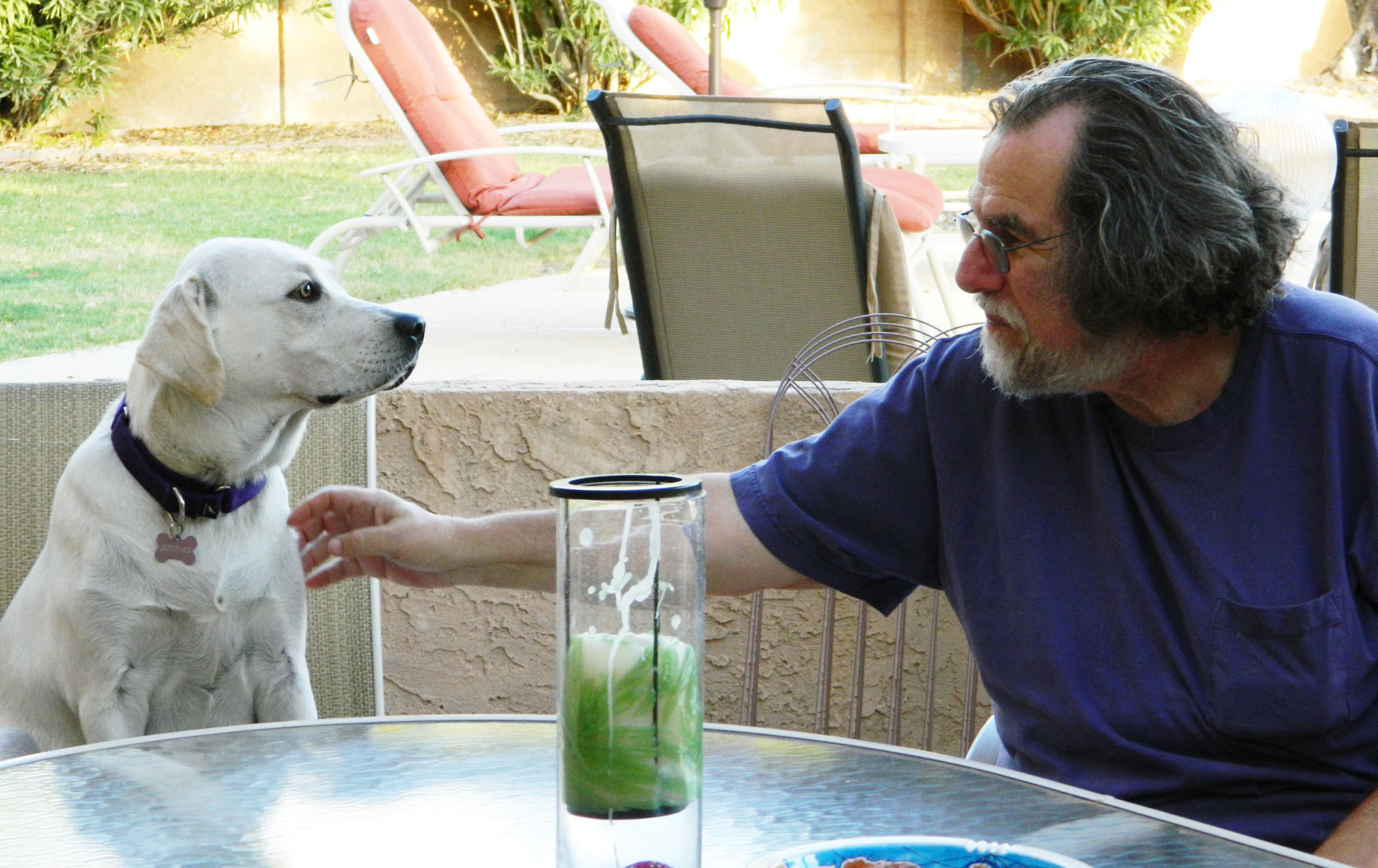
ken sadie table

Biography:

Having retired from a career in psychology, Kenneth Weene turned to his dream profession, writer. Weene has published many poems and short stories in a variety of venues. With four novels currently available, Ken continues to pen away. He can be found on most social media or via his website, www.kennethweene.com  To find his books, visit http://www.amazon.com/Kenneth-Weene/e/B002M3EMWU

(As many of you will know, myself and fellow authors have published an anthology to raise money for the Guide Dogs for the Blind association. The anthology is free to download but it will be much appreciated if you could please make a donation to Guide Dogs when doing so. For details of the anthology please visit: http://newauthoronline.com/anthology-to-raise-money-for-guide-dogs/)

Poetic Enrichment – a guest post by Kay Kauffman

Many thanks to Kay for the below guest post. If you are interested in doing a guest post please contact me at newauthoronline (at) gmail . com

Hello! My name is Kay, and I’m a poet. I don’t just love writing poetry, though – I also love reading it. My poetry habit began when I was a child and I discovered Shel Silverstein’s work (if you haven’t read A Light in the Attic or Where the Sidewalk Ends, add them to your to-be-read list pronto). When I was ten, I discovered Joan Walsh Anglund’s work; The Song of Love is one of my most treasured books.

As I grew older, so, too, did the poetry I read. Nineteenth century poets, eighteenth century poets – none were too musty or dusty for me. I finally worked my way back to Shakespeare, of whom I couldn’t get enough. I had to read his sonnets with a dictionary, but I didn’t mind. It only became a problem when I’d get caught up in reading the dictionary instead of the sonnets. 🙂

But there are worse problems to have. Reading the dictionary turned out to be a major boon to my own poetry by increasing my vocabulary. On the flip side, though, my husband now refuses to play word games with me. Learning about the history and formations of different words is fascinating, though, especially if, say, you’re trying to create your own language for the fantasy world you’ve spent a decade creating.

Not that I would know anything about that… 🙂

Poetry has enriched my life in countless ways, and I could no sooner choose a favorite poem than I could a favorite star in the sky. What about you? What are some of your favorite poems? How has poetry affected your life?

As a girl, Kay dreamed of being swept off her feet by her one true love. At the age of 24, it finally happened…and he’s never let her forget it. A mild-mannered secretary by day and a determined word-wrangler by night, she battles the twin evils of distraction and procrastination in order to write fantastical tales of wuv…twue wuv…with a few haiku thrown in for good measure.

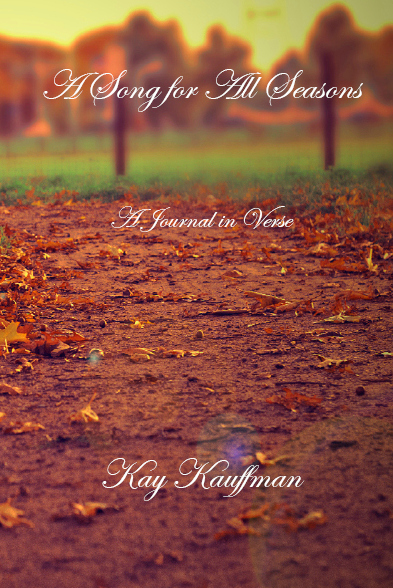
The author of Tuesday Daydreams: A Journal in Verse and A Song for All Seasons: A Journal in Verse, Kay is currently hard at work on the first book in a fantasy trilogy. She resides in the midst of an Iowa corn field with her devoted husband and his mighty red pen; four crazy, cute kids; and an assortment of adorably small, furry animals.

Tuesday Daydreams captures the life and imagination of the author in vivid detail, touching on joy and loss, life’s everyday hassles, and the many faces of Mother Nature. A Song for All Seasons paints vivid pictures of the Iowa landscape in all its glory, in addition to intimate portraits of family life. From frost-covered windowpanes and snowy vistas to rolling green fields and bright blue skies, each poem is a peek into a fading world of untamed beauty. If you’d like to pick up your own copy of Tuesday Daydreams or A Song for All Seasons, you can find them at Amazon, Amazon UK, Createspace, Smashwords, iBooks, Kobo, and Barnes & Noble.

Care to save her from the chaos? You can find Kay in the all the usual places:

At her blog, where she shares random pictures and silly poems; on Facebook, where she shares things about cats and books; on Twitter, where she shares whatever pops into her head; on Pinterest, where she shares delicious recipes and images from her fantasy world; on Instagram, where she shares pictures of pretty sunsets; and on Tumblr, where she shares all of the above.

ASFAS-Ecover TD-Ecover wpavi

Interview With Author Paul G. Day

Thank you to author Paul G. Day for the below interview.

Disclosure: I will receive 5 of Paul’s ebooks free as thanks for having interviewed him.


Interview With Author Paul G. Day


  1. At what age did you begin to write?

I wrote a bit at school, but nothing too serious. I really didn’t begin writing until I was thirty. I was always good at stories and had a fair bit to do with young people, so I combined those two passions into writing. But, it wasn’t until I went to university in 1996 that my love for writing really took off. I studied Fiction for Young Readers, Classic Literature, Shakespeare and Writing for Young People while I was majoring in English and Drama. It was a combination of all this learning that started me on my journey to develop my own craft, my own style and the genres I wanted to write in. In 2012 I published my first book and since then I have published seventeen more books for children and young adults.

  1. Do you write full-time or do you have a job other than writing?

I am a Teacher and was working full time up until two years ago. I decided to resign and do relief teaching part time due to health, but it freed up a lot of time to work on writing. I don’t write books every day, but I do practice some form of writing every day, even if it is simply to update my blog. When I am not doing that I am writing poetry. I don’t think writers should feel locked in to having to write. I write when I am inspired to do so, but once I do start it is difficult to stop. More important than writing regularly is finishing projects and that is something I challenged myself to do early on.

  1. When does your writing take place? (I.E. morning, afternoon or evening).

It varies. I write mainly when my wife is at work or late at night. I have been known to keep writing on occasions until dawn. Lol. Like I said, once I start, I find it difficult to stop.

  1. Do you plan your books or write off the cuff?

A bit of both. Some of my books started out as poems that people enjoyed. Sometimes my writing is straight from the heart and although I have an idea of the direction I want to go, I let the story tell itself. You would be amazed where the journey can take you if you open yourself up to all possibilities. However, lately, especially with writing for a more mature audience, I find I am forced to plan and research more thoroughly to get it exactly right.

  1. Can you provide a summary of your books (I.E. their subject matter).

My latest book, Children of Mars is a science fiction novel aimed mainly at young people aged 14 and older. It is a story about a group of children who find themselves at the mercy of Mars in the absence of their parents, who went missing on an apparently routine mission. It is a story of survival, of resilience and of a coming of age. But it is also a story of self sacrifice, courage and love. The book deals with loss and death with sensitivity and follows different characters at different stages in the story, shifting perspective between them so that the reader has a better sense of their personal and shared struggle. Thrown into the mix, as you would expect given the genre, is a strange set of supernatural events, culminating in a finale that I hope will leave the reader breathless.

  1. Have any other authors influenced you and, if so how?

I am greatly influenced by writers such as Isaac Asimov and Arthur C. Clarke, but I also love the work of some of the classic writers such as Charles Dickens, who I believe was one of the greatest writers of his era. I have also read H. G. Wells, Tolkien, Shakespeare, Charlotte Bronte, Jane Austin and a number of other authors’ works. I believe Dickens understood the children of his generation better than any writer before or since. He often wrote of the squalor, the appalling poverty and the terrible waste and death that children of the time were exposed to. His stories speak to the heart and must have had a tremendous impact on the rich and poor of the day.

  1. If you only had space for one book what would it be and why?

It would be The Black Fairy & The Dragonfly. Even though it is a fairy tale and the main character is female, I feel more attuned to the themes, the rhythm, the narrative voice and the journey of the main character than anything else I have written. There is more of me and my personality in this series than in any other book and I have to say it is just as much my favorite as it is others.

As far as other books are concerned, well, I would have to say the Bible and the Complete Works of Shakespeare if I could fit them both on the shelf. But I would still make room for my little book too. Lol.

  1. How do you react to negative and/or bad reviews?

Not very well I’m afraid, not in the first instance at least. I tend to be offended and then after thinking about it, I try to look at it objectively and draw something positive from it. I have had one very bad review which absolutely annihilated Children of Mars, but when I looked into who wrote it and saw a sample of her own work, which in mu humble opinion is just terrible in every way, I felt a lot better. This person was more concerned with editing my book than critiquing its merit. So, I swallowed my pride and moved on. After all, the vast majority of readers love my books. 94 reviews (on Amazon alone) with an average of 4.5 stars isn’t bad really. Lol.

  1. Is there anything you would like to say to your readers and/or fellow authors?

I would like to say thank you to my readers, some of whom have read many of my books. If not for them, this whole publishing gig would not be worth it. When I read a review like I did recently which said the story touched them deeply and personally, this is all I need to keep writing. So, thank you to all those people who believed in me, bought and reviewed my books and keep in touch even today. Your comments, responses, messages of support, plus the fact you own at least one of my books, will be cherished always. To my fellow authors I say this: Nothing worthwhile comes easily or without sacrifice and a whole heap of effort and even some pain. If it’s worth writing and you hunger to have it finished, do not let anyone or anything stop you from telling the stories only you can.

  1. Is there anything not covered in the above questions which you would like to add?

I would like to say that anyone who buys one of my books is in for a special, unique and interesting journey. I pour a little of myself into every paragraph, every chapter of every book. Even the children’s books I have written are imbued with my personality. If you want to know what makes me tick and learn about me as a person, read my work. It’s all there, warts and all. I guarantee you will be inspired, you will respond with emotion, you will remember these stories. If you do read one of my books and find yourself so moved, please make sure you visit my sites and leave a message. You will be making my day.

Also, thank you Kevin for taking the time to write this interview. It is very much appreciated and I have enjoyed writing my responses to your thoughtful questions.


Repair Man

My grandfather used to do this self-same job. Who would have thought that the occupation would still be going strong after all these years. He would be amazed to see how the job has changed. I’m sure he wouldn’t believe what we repairers do these days and, if he did then chances are he wouldn’t like it.

Progress is a funny thing. You can’t stand in the way of progress. I mean society’s so much more stable now, crimes practically vanished. I’m proud that in a small way I’m contributing to a safe society one in which my girlfriend can walk the streets free from the fear of molestation and where our kids can play out without my partner and I constantly worrying about them.

The technology has improved so much. When I was a boy you had big bulky box-like objects standing on legs or in cabinets in the corner. There are still a few of the old tellies around. I wish I haden’t given grandfather’s away. You see the old sets from the 70’s and 80’s going for mega bucks on the web. Those from the 50’s and 60’s go for even more. Of course the old sets don’t work with digital, people just like to have something retro in the corner to look at. It’s a talking point when visitors come around.

The new sets break down fairly regularly. It’s a scandal that they need fixing as often as they do, especially as they cost so much to produce. But then you can’t put a price on security can you?

It tends to be the older generation who are resistant to new technology. Some of them have even been known to obstruct the television or even break them. Why break a perfectly good TV? It beats me.

Of course its not compulsory to have a TV but you get looked at askance if you don’t have one. Anyway there are so many incentives to have a TV that practically no one is without one. Because of advertising most of the channels are free and you get a reduction in your taxes if you have a set. It isn’t a big tax cut but it’s worth having. The girlfriend and I used the money we saved following the installation of our all singing, all dancing set to take the kids abroad.

It was strange being in that foreign hotel room. We had a telly, I can’t imagine being without one but it was odd. I mean it was just a set for watching programmes. Sure you could go online with it (all modern sets have that capability) but it didn’t do the thing everyone (well the majority of people) are used to and accept in my country.

“You know Rob its kind of nice to be alone. Just you, me and the kids” Jenny said.

“Those who have nothing to hide have nothing to fear”, I said.

Who needs privacy. We’ve got a good standard of living. Society is stable and secure now. I’m proud that in a very small way, as the installer of sets which both receive and transmit I’m contributing to the happiness and prosperity of my fellow citizens.

The Literary Robots Are Coming!

Back in January I wrote a piece of flash fiction entitled “Robert” (http://newauthoronline.com/2015/01/18/robert/). In that story I imagined a robot capable of producing works of literature on a par with those of Tolstoy and Dickens. While browsing the internet yesterday I came across the following article which reminded me of Robert, (http://readwrite.com/2013/01/15/why-write-your-own-book-when-an-algorithm-can-do-it-for-you). Should authors be worried? I have my own views but would be interested to hear from fellow authors and readers. Should we authors all jump off the white cliffs of Dover before the machines come for us?


Kevin

My Past Five Years As A Blogger – My Guest Post On Cupitonians

Many thanks to Anju for inviting me to lull her readers to sleep, err I mean entertain them! By writing about the past five years of my life as a blogger. For my guest post please visit (https://cupitonians.wordpress.com/2015/04/15/last-5-years-by-new-author-online/).


Kevin

Nobody Knows This Little Rose By Emily Dickinson

The below poem by the American poet, Emily Dickinson is deceptive in it’s simplicity. The final 2 lines arrest the attention of the reader,


“Ah Little Rose — how easy

For such as thee to die!”.


Nobody Knows This Little Rose By Emily Dickinson


Nobody knows this little Rose —

It might a pilgrim be

Did I not take it from the ways

And lift it up to thee.

Only a Bee will miss it —

Only a Butterfly,

Hastening from far journey —

On its breast to lie —

Only a Bird will wonder —

Only a Breeze will sigh —

Ah Little Rose — how easy

For such as thee to die!

Orphaned: A Guest Post By Kerry Kijewski

Many thanks to Kerry Kijewski for the below guest post.


Kevin


Literature has always had an impact on my life, for as long as I can

remember, and I love it because it is where so many lessons and themes about

life can be found.


Over the years, as my love of these stories and characters grew, I began to

notice something interesting.


I seemed to be drawn to a group of fictional characters, all with a common

thread of similarity.


What might this be?


Three of my most favourite characters in all of literature are: Anne

Shirley, Frodo Baggins, and Harry Potter.


What do these three have in common?


They are, all three of them, orphans.


Anne of Anne of Green Gables fame, my favourite Canadian, red-haired

heroine, was orphaned as an infant. She grew up, being passed from home to

home, finally settling with Marilla and Mathew Cuthbert, an elderly sister

and brother, purely by mistake. This began her life finally, her first

experience with being wanted and loved. Of course, her early life

experiences had a profound affect on the person she would become.


Then there’s Frodo Baggins. This main protagonist and ring bearer of The

Lord of the Rings was orphaned, too, as a child. Eventually he would end up

living with his uncle Bilbo, who had carried the ring before him. Frodo was

adopted by Bilbo, taken in like a son, and from there his life is majorly

changed and his adventure truly begins.


And finally, Harry Potter was orphaned at one years old, when his parents

are murdered in cold blood by the most evil wizard of all time. He was

nearly killed himself, but some secret magic gave him an unexpected

protection. He spends the next decade, raised by his aunt and uncle, who do

not want him and do not bother to hide the fact that they don’t. His world

is only changed for the better when he discovers he has been accepted to

Hogwarts, a school for young witches and wizards. He finally has friends and

those friends become his family, in all the ways that matter.


“Mrs. Weasley set the potion down on the bedside cabinet, bent down, and put her arms around Harry. He had no memory of ever being hugged like this, as though by a mother.”

—Harry Potter and the Goblet of Fire


So why, do you ask, am I attracted to these orphaned characters? Precisely for the reason illustrated in this quote.


I believe this is because I have experienced the exact opposite in real

life. I could not imagine what it would be like to not know what it felt like to be hugged and comforted when I was upset.


I was born into a loving family, with adoring parents and three siblings. I

had security and never felt, for one second, that I was unwanted or

unloved.


I believe we read fiction to escape into another world, yes, but also to

learn about worlds we, ourselves, have not known. We read to learn what it’s

like for someone else, at least I do.


I am fascinated by how a child can grow and develop character and still come

out with empathy and love, when they themselves did not have love as

children, to learn what love means all the more because they missed out from

the beginning.


I can’t imagine what it must feel like to not have love and not to be adored

and nurtured. I read Anne of Green Gables, Lord of the Rings, and Harry

Potter to study their main characters and how they interact with others. I

feel empathy for these characters, fictional as they are, and I am all the

more thankful and appreciative of what I’ve had in my own life.


That, I think, is what truly wonderful fiction can do.


Bio:


Kerry is a writer and blogger. She loves all things books and literature. She writes to make sense of the world around her. She believes life is one big headache, equal parts painful and beautiful.


She blogs at


https://kkherheadache.wordpress.com


You can find her at Facebook and on Twitter:


https://www.facebook.com/herheadacheblog


She lives in Ontario, Canada with her literary themed dog Dobby and cat Lumos.

Can Anyone Name The Novel In Which The Following Dialogue Takes Place?

A question for you. Can anyone name the novel in which the following dialogue takes place?

“Sir, on hearing you speak I am reminded of Shakespeare”.

“Really! My conversation has the ring of Shakespeare about it!You compliment me. To which heroic character do you refer?”

“I refer sir to Macbeth and the lines voiced by him as he nears his end, namely

“a poor playerThat struts and frets his hour upon the stage

And then is heard no more: it is a tale

Told by an idiot, full of sound and fury,

Signifying nothing”.

My Author Interview On Sally G. Cronin’s Blog

Many thanks to Sally G. Cronin for taking the time to interview me for her blog. You can find my interview by clicking here, (https://smorgasbordinvitation.wordpress.com/2015/04/12/the-sunday-show-defining-moments-with-kevin-morris/).


Kevin