Will poetry make you any smarter or wiser?

I am not sure that poetry makes a person any smarter or wiser. Poetry is, in the final analysis it’s own point. We take from a poem what resonates with us. We share the joys, sorrows, anger etc of the poet or, on occasions disagree with the poem’s message (always assuming of course that it has one and, if it does that we have understood it correctly). Ultimately poetry matters in and of itself. Kevin

Maja Todorovic's avatarBusiness in Rhyme

dead-poets-society

Few nights ago, almost after 20 years I watched “Dead poets society” movie again. Having poetry as  my regular friend and companion sheds completely new light not only on the understanding of the movie itself, but on the distance I made from a person I used to be to a person I believe I am today.  When I first watched movie, it was more interesting from a teenage point of view – I was in high school and it was amusing to relate to main characters’ early adolescent ups and downs. I certainly don’t attempt to analyze the movie here, but two main messages stuck to my mind after the second watch: how poetry so beautifully offers that different perspective, seeing world from another angle, through different color of lenses, walk in the shoes that can be too tight and make blisters or two big that make us feel clumsy…

View original post 492 more words
Its Raining

Its raining out there.
I swear
That I will go out later,
But, seeing an alligator
I shall continue to reside
Safely Inside!

Perhaps I am in denial
And it is a crocodile
That lurks below.
Maybe I should my resolution harden
And go out into my garden
With my dog
And admit that that fearsome creature is, in fact a log …!

I maintain
That despite the rain
Crocodile and alligator
That I will go
Below
But let it be later …!

Five Fascinating Facts about Ovid

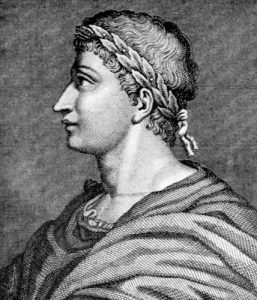
I am awaiting the delivery in braille of Ovid’s Metamorphosis. RNIB now offers a braille on demand service which is, I guess the way in which the world is going.

InterestingLiterature's avatarInteresting Literature

Interesting facts about a classic Roman poet

1. Ovid wrote a tragedy about Medea, but it has not survived. This is particularly galling since the Roman rhetorician Quintilian thought this among Ovid’s finest work – and this is a poet who also gave us the fantastic (in more ways than one) catalogue of myths and legends, the Metamorphoses. How much Ovid’s work about the sorceress who killed her own children owed to Euripides’ celebrated play Medea is not known, and now probably never will be.

View original post 438 more words

Venus and Baccus

Venus wants new shoes
And knowing not which pair to choose
Turns to Baccus who, lost in wine
Thinks her divine
And, taking out his credit card,
(For he has no hard cash)
Does, in a moment rash
Buy the lot
For he has got
More money than sense.
No expense
Will he spare
To keep Venus fair
At his side,
Though in rare
Moments of sobriety, he feels a lack of pride in self
And turning to the shelf
Pours another drink
Until he does into forgetfulness once more sink.

Sobriety does hurt,
For it makes Baccus alert
And causes him to think on the variety
Of nymphs he has known
And ponder on why he has always felt alone.
Picking up the telephone,
Venus arranges to get her hair
Done, for a girl must have fun
And take care of herself.
She has her man’s wealth
And a good lawyer lined up for when it all goes awry,
For Venus knows that his passion will die
And she will catch the eye
Of another rich guy
Who, like Baccus, lacking sense
Will spare no expense
In buying everything
Save for happiness, for that money can not bring,
Though the cynics say, it does soften lonleness’s sting …

A Short Analysis of T. S. Eliot’s ‘What the Thunder Said’

InterestingLiterature's avatarInteresting Literature

A reading of the fifth section of The Waste Land

‘What the Thunder Said’ concludes The Waste Land, T. S. Eliot’s landmark 1922 work of modernist poetry. In many ways, this is the most difficult section of The Waste Land to analyse. Nevertheless, what follows is an attempt to sketch out one possible reading or analysis of ‘What the Thunder Said’ in terms of its meaning, language, and use of literary allusions. You can read ‘What the Thunder Said’ here.

In summary: things really begin to break down properly here. In the previous four sections of The Waste Land, Eliot had used a number of different poetic forms and metres, and although the poetry occasionally broke down into what we might call free verse, it usually regained its form after a while. But ‘What the Thunder Said’ is overwhelming written in unpunctuated, unrhymed, irregular free verse.

View original post 807 more words

Plain as a Pikestaff

I have lost myself in arms
Heedless of alarms
That warn of expensive charms.

I have smelt
The rose and felt
Its power,
Losing precious hour
In many a rented bower.

I have seen it all, plain as a pikestaff
And heard Nemesis’s mocking laugh.
Yet oft times a man learns too late
That he makes his own fate.

Chartwell: home of Sir Winston Churchill – another ‘jolly.’

They don’t make them like that anymore. Chartwell is a place I have long wished to visit. Kevin

Jane Risdon's avatarJane Risdon

Churchilll's Golden Wedding (c) Jane Risdon 2016Buying Chartwell for  Churchill (c) Jane Risdon 2016
Chartwell from the rear (c)Jane Risdon 2016Chartwell from the rear (c)Jane Risdon 2016

Churchill's home (c) Jane Risdon 2016                 (c) Jane Risdon 2016

Late September I was fortunate enough to visit Chartwell, home of Sir Winston Churchill.

‘Some day, some year, there will be old men and women whose pride it will be to say “I lived in Churchill’s time”.’ The Evening Standard on the day of Churchill’s funeral.

A friend’s father – in the Navy at the time – was one of the men to carry Churchill’s coffin to the train for his final journey to Bladen, Oxfordshire, where he is buried.

(c) Jane Risdon 2016(c) Jane Risdon 2016

Churchill lived at Chartwell with his family from 1922 until his death in 1965. In common with most people he moved home several times during his life-time, progressing gradually to a larger and grander property as circumstances and his…

View original post 1,677 more words