There was a young man called Baccus
Who caused a bit of a fraccus
By getting drunk one day
And leading his colleagues astray.
Our employer he threatened to sackus!
There Was A Young Man Called Baccus
Leave a reply
There was a young man called Baccus
Who caused a bit of a fraccus
By getting drunk one day
And leading his colleagues astray.
Our employer he threatened to sackus!
A great poet and musician has left us, (https://www.youtube.com/watch?v=Xk7DOe5EGgM).
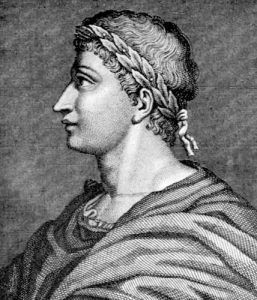
I am awaiting the delivery in braille of Ovid’s Metamorphosis. RNIB now offers a braille on demand service which is, I guess the way in which the world is going.
Interesting facts about a classic Roman poet
1. Ovid wrote a tragedy about Medea, but it has not survived. This is particularly galling since the Roman rhetorician Quintilian thought this among Ovid’s finest work – and this is a poet who also gave us the fantastic (in more ways than one) catalogue of myths and legends, the Metamorphoses. How much Ovid’s work about the sorceress who killed her own children owed to Euripides’ celebrated play Medea is not known, and now probably never will be.
View original post 438 more words
Venus wants new shoes
And knowing not which pair to choose
Turns to Baccus who, lost in wine
Thinks her divine
And, taking out his credit card,
(For he has no hard cash)
Does, in a moment rash
Buy the lot
For he has got
More money than sense.
No expense
Will he spare
To keep Venus fair
At his side,
Though in rare
Moments of sobriety, he feels a lack of pride in self
And turning to the shelf
Pours another drink
Until he does into forgetfulness once more sink.
Sobriety does hurt,
For it makes Baccus alert
And causes him to think on the variety
Of nymphs he has known
And ponder on why he has always felt alone.
Picking up the telephone,
Venus arranges to get her hair
Done, for a girl must have fun
And take care of herself.
She has her man’s wealth
And a good lawyer lined up for when it all goes awry,
For Venus knows that his passion will die
And she will catch the eye
Of another rich guy
Who, like Baccus, lacking sense
Will spare no expense
In buying everything
Save for happiness, for that money can not bring,
Though the cynics say, it does soften lonleness’s sting …

A reading of the fifth section of The Waste Land
‘What the Thunder Said’ concludes The Waste Land, T. S. Eliot’s landmark 1922 work of modernist poetry. In many ways, this is the most difficult section of The Waste Land to analyse. Nevertheless, what follows is an attempt to sketch out one possible reading or analysis of ‘What the Thunder Said’ in terms of its meaning, language, and use of literary allusions. You can read ‘What the Thunder Said’ here.
In summary: things really begin to break down properly here. In the previous four sections of The Waste Land, Eliot had used a number of different poetic forms and metres, and although the poetry occasionally broke down into what we might call free verse, it usually regained its form after a while. But ‘What the Thunder Said’ is overwhelming written in unpunctuated, unrhymed, irregular free verse.
View original post 807 more words
I have lost myself in arms
Heedless of alarms
That warn of expensive charms.
I have smelt
The rose and felt
Its power,
Losing precious hour
In many a rented bower.
I have seen it all, plain as a pikestaff
And heard Nemesis’s mocking laugh.
Yet oft times a man learns too late
That he makes his own fate.
They don’t make them like that anymore. Chartwell is a place I have long wished to visit. Kevin
 Buying Chartwell for Churchill (c) Jane Risdon 2016
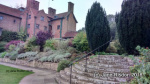 Chartwell from the rear (c)Jane Risdon 2016
 (c) Jane Risdon 2016
Late September I was fortunate enough to visit Chartwell, home of Sir Winston Churchill.
‘Some day, some year, there will be old men and women whose pride it will be to say “I lived in Churchill’s time”.’ The Evening Standard on the day of Churchill’s funeral.
A friend’s father – in the Navy at the time – was one of the men to carry Churchill’s coffin to the train for his final journey to Bladen, Oxfordshire, where he is buried.
 (c) Jane Risdon 2016
Churchill lived at Chartwell with his family from 1922 until his death in 1965. In common with most people he moved home several times during his life-time, progressing gradually to a larger and grander property as circumstances and his…
View original post 1,677 more words
Walking through these fallen leaves, I think of Ozymandias.
All things pass.
The rotten
Is soon forgotten
And all
Idols fall.
Have a care
For oft times despair
Comes upon a man unaware
And does him hold
In it’s cold
And empty stare.
(This poem was composed on 10 November 2016. I did consider whether it should be longer. However where it to be of greater duration, I would, perforce have had more to say. I did not, for the feeling of despair has no expression other than a sense of cold and blank emptiness. Consequently to say more would have been to employ words for the sake of employing them.
This poem came to me in the wee small hours. I did not (and do not) feel despair’s great weight pressing down on me. Many of us have, however felt the deadness that constitutes despair at some point in our lives).
There was a young man called Marcello
Who loved to play on the cello.
He wasn’t very good
And his neighbours would
Bang on the walls and bellow!
—
There was a young man called Marcello
Who loved to play on the cello.
He played at night,
Giving his neighbours a fright.
They would bellow, “stop that racket Marcello”!


 K Morris - Poet