Monthly Archives: November 2017

►Greek Mythology: “Pandora and Helen of Troy” / “Collaboration with Carolee Croft”🍎.-

An interesting post on the role of women (particularly Helen of Troy and Pandora) as portrayed in Greek Mythology, followed by a story imagining what happens after Pandora opens the box which released evil upon the world.

Aquileana's avatar⚡️La Audacia de Aquiles⚡️

►Greek Mythology: Pandora and Helen of Troy, Misogynistic Stereotypes” /

“Collaboration with Carolee Croft”🍎:

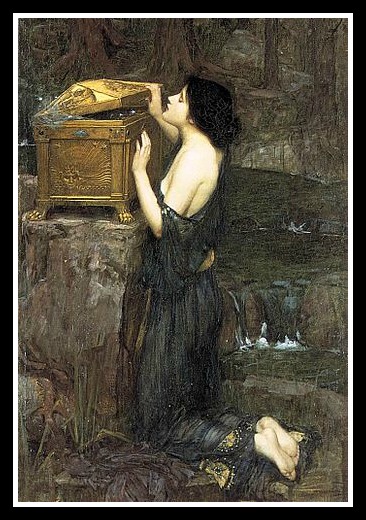
“Pandora” by John William Waterhouse. 1896.

______________________________________________________________

“With the curse, comes a blessing. Zeus wanted to punish humanity by creating you, the first woman, and by giving you that box filled with curses such as illness, war, and poverty. But if you look inside the box, one thing remains. It is hope”… (“After the Evil Spirits are Unleashed”. Carolee Croft).-

⇒♦ Introduction and Sketch of this post:

Greece is widely known as the birthplace of democracy, freedom of speech and thought, and egalitarian life. But in ancient Greece, women had no political or social rights. In Ancient Greece, males hold primary power and predominate in roles of political leadership, political and social privileges and authority. This, in practice came along with prejudices against women, belittling of women, and their exclusion, and Misogyny in many ways. 

View original post 3,233 more words

Shoppers

I pass the lights
And think on the delights
Inside
Where shoppers hide
From the cold outside
Where people hurry by
And do not catch another’s eye.

What man will glorify the ethereal
When there is a material
Girl with perfect skin
Who beckons him in
To her store?

Those who are discreet
Do not ask for a receipt.
They know the power
Of the shower
And how scent lingers
On fingers.
But one can not forever hide
From the cold outside

Online Distractions

Yesterday evening (Sunday 26 November), found me contentedly sitting on the sofa in my living room, reading a recently purchased braille edition of Robert Frost’s “North of Boston”, http://www.gutenberg.org/files/3026/3026-h/3026-h.htm. On turning to the final poem in “North of Boston”, which is entitled “Good Hours” https://www.poets.org/poetsorg/poem/good-hours, I came across the word profanation.

Being wholly unfamiliar with the word I was keen to ascertain its meaning. I had, however turned off my computer (quite deliberately as I wished to spend the remainder of Sunday evening reading, undisturbed by technology). I do not own a braille dictionary (they are, to my knowledge no longer produced as blind users can access online dictionaries), consequently the only way in which I would have been able to find the definition of profanation would have been by turning on my computer or looking up the word using the search engine on my mobile phone, (both devices are equipped with screen readers which convert text into speech and braille).

To cut a long story short, due to my unwillingness to succumb to the demon of technology, I left my curiosity unsatisfied until this evening (Monday 27 November).

I spend much of my life engaging with technology. My job entails the use of a computer Monday through to Friday, while my poetry is written using a laptop. Consequently I relish time away from electronic gadgetry, hence my disinclination to engage with technology yesterday evening.

I do, of course recognise the value of online reference books. Language is constantly evolving and it is not always convenient to lug a heavy dictionary around with one. However, when writing it is easy to go to one of the many online dictionaries, only to get caught up with online distractions such as webmail, social media etc. Had I the choice, I would not go online while writing but would rely on a good old-fashioned paper dictionary. However given the absence of braille dictionaries (as explained above) I have no option other than to use the internet. I will, however continue to avoid the temptation to go online during my leisure time, while reading for pleasure. We all, in my view benefit when we take a break from the World Wide Web and technology more generally.

Incidentally, for anyone interested in ascertaining the meaning of profanation, Merriam-Webster defines it as follows:
“the act or an instance of profaning”, https://www.merriam-webster.com/dictionary/profanation

Did You Hear The Owl?

“Did you hear the owl?” I said, as we sat in my living room.
(It will be over soon.
The prey caught
I thought).

“No” you replied.
Twice more the bird cried
But you heard
Not a word
He said.

The bed
Was hot
And the owl you did not see
Forgot by me.