Category Archives: Uncategorized

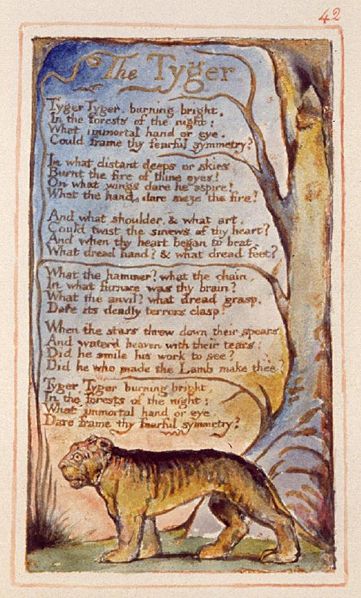
A Short Analysis of William Blake’s ‘The Tyger’

InterestingLiterature's avatarInteresting Literature

A critical reading of an iconic poem

‘The Tyger’ is arguably the most famous poem written by William Blake (1757-1827); it’s difficult to say which is more well-known, ‘The Tyger’ or the poem commonly known as ‘Jerusalem’. The poem’s opening line, ‘Tyger Tyger, burning bright’ is among the most famous opening lines in English poetry (it’s sometimes modernised as ‘Tiger, Tiger, burning bright’). Below is this iconic poem, followed by a brief analysis of the poem’s language, imagery, and meaning.

Tyger Tyger, burning bright,
In the forests of the night;
What immortal hand or eye,
Could frame thy fearful symmetry?

In what distant deeps or skies.
Burnt the fire of thine eyes?
On what wings dare he aspire?
What the hand, dare seize the fire?

View original post 767 more words

Ere We Die

Thank you to Pax Et Dolor Magazine for publishing my poem “Ere We Die”.

PaxEtDolor Magazine's avatarPax Et Dolor Magazine

By :- Kevin Morris

On seeing the stormy sky
The poet thinks “man must die”.
He sees the young girl bloom
And says “she is destined for the tomb”.
Oh let us gather wild flowers
And not waste our powers
Trapped in ivory towers.
Beware the scholar’s domed head
For we are soon dead.
May our spirit fly
Ere we die
And are lost in endless sky.


The copyrights on the article belong to the author. The responsibility for the opinions expressed in the article belongs exclusively to the author. Find more of his beautiful works at newauthoronline

The poem appears in his
collection of poetry, “Lost in the Labyrinth of My Mind

View original post

And Then They Murdered Jane Austen

Kristen Twardowski's avatarKristen Twardowski

writer

When I say that they murdered Jane Austen, I’m not speaking metaphorically. Some person in the distant past didn’t simply eviscerate her work. No, I mean that a few scholars believe that someone poisoned Jane Austen. With arsenic.

According to research from the British Library, Jane Austen’s death at the age of 41, her early cataracts, and her strange facial pigmentation are all consistent with the effects of arsenic poisoning.

Some scholars say this sounds like murder. Others remind us that arsenic was often used in medicine; even Austen’s death resulted from the chemical, there may not have been anything nefarious about it. And still other scholars grumble that these claims are nothing more than academic click bait.

Whatever the truth is, the subject is a fascinating one. I suggest you read all of the British Library’s blog post on the subject before coming to your own conclusions. We always…

View original post 19 more words

Returning Author – Tori Zigler

A good article by my author friend Tori Zigler. I particularly agree with Tori’s comments regarding authors reviewing fellow author’s work and her point about writer’s commenting on reviews of their books. Kevin

eranamage's avatarLibrary of Erana

I’d like to welcome back author Victoria Zigler, or Tori, if you prefer.

Please recap briefly about your books:

Most of my books are fantasy stories, fairy tales, animal stories, or some combination of those, but I’ve also written books in other genres too.  Regardless of genre though, my stories are aimed at children.  I happen to know that some adults have really enjoyed them too, however, and I’m not just talking about adults who are family members or friends either.

Not all my books are children’s stories.  I also write poetry, which is generally suitable for any age level, and has also been enjoyed by adults and children alike.

Plus, I have a fantasy story published in the “Wyrd Worlds II” anthology.

What has changed since you last visited? Tell us your news!

The last time I was interviewed on here, I was about to release the final book…

View original post 2,396 more words

Under The Stars

K Morris Poet's avatarK Morris - Poet

Looking for a saviour under the stars

Men slow then stop their cars.

Girls under street lamps stand

Waiting for their lord’s command.

Needle pricks scar their arms

Still men discern a certain charm.

Girls think of their next fix

Man moistens his dry lips.

“I seek a saviour of a kind

In the hope some inner peace I may find”

He says shuddering at her needle lines.

“Your saviour I will be

Provided you can pay my fee.

A girl must live. Love isn’t free”,

She says gazing at a distant tree.

She thinks of her girlhood not so long ago

Of trees their boughs bent under the weight of snow.

She thinks “once I could not be bought

Before hard drugs their damage rought”.

The man holds out cold hard cash

She takes it with a bitter laugh.

Stepping in through the car’s open door

She wonders if…

View original post 70 more words

The Best Kind of Bot: The New Yorker’s Poetry Bot

Kristen Twardowski's avatarKristen Twardowski

As many of you know, I am a poetry nerd, which is why I am incredibly excited to share The New Yorker’s new Poetry Bot.

By following the Bot on Twitter or Facebook Messenger, people can receive excerpts from different poems every day for the next three months. The poems have been chosen by The New Yorker’s poetry editor and coordinator and include works by Audre Lorde, Dorothy Parker, Joseph Brodsky, and many, many more.

Poetry Bot.PNG

To begin following the Bot, simply follow the instructions listed at The New Yorker’s post. This is a great way to discover new poets, and I’m thrilled that it exists.

And fun fact: the Bot was created by the same folks who made an interactive fortune-telling bot and the Harry Potter-esque “Sorting Bot”, which sorted followers into Hogwart’s houses using rhyming quatrains. Technology really can be grand.

View original post

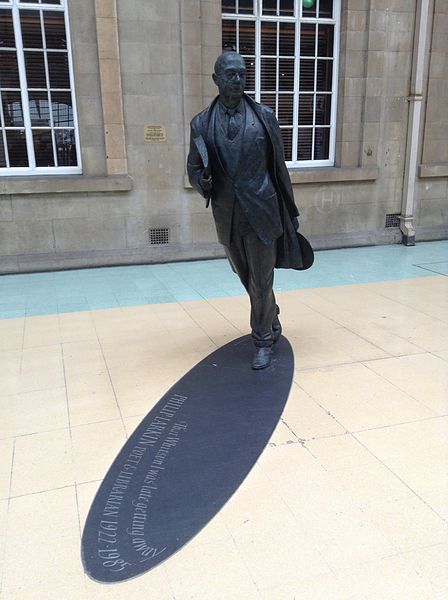
A Short Analysis of Philip Larkin’s ‘Aubade’

Along with Larkin’s “Ambulances”, his “Aubade” is, I think my favourite Larkin poem. Larkin tells it as it is, however uncomfortable that may be.

InterestingLiterature's avatarInteresting Literature

A summary of Larkin’s last great poem

An aubade – the term is from the French – is a song or poem in praise of the dawn, but Philip Larkin’s ‘Aubade’ is somewhat different. Although the meditation in the poem takes place during the early hours of the morning, there is none of the celebratory zest found so often in poetic aubades. Instead, Philip Larkin’s ‘Aubade’ is a poem about death, and specifically the poet’s own growing sense of his mortality. You can read ‘Aubade’ here; in this post we offer some notes towards an analysis of this, the last great poem Larkin ever wrote.

Philip Larkin completed ‘Aubade’ in November 1977, and the poem was published in the Times Literary Supplement on 23 December – ruining quite a few Christmas dinners, as Larkin himself predicted. He had begun the poem in 1974, the year that his final collection

View original post 1,088 more words

Kevin Morris reading his poem ‘To my dog Trigger, who lay on my book’.

While drinking in my favourite local pub, The Railway Bell (http://www.rampubcompany.co.uk/visit-pubs/railway-bell), I left my rucksack, which contained a copy of my book ‘Lost in the Labyrinth of my mind’ (https://www.amazon.co.uk/Lost-labyrinth-my-mind-Morris-ebook/dp/B01AF5EPVY) on the floor. My guide dog Trigger made himself comfortable on both book and rucksack, creasing ‘Lost’s pages, which led to the composition of this poem.

The poem can be found in Refractions: https://www.amazon.co.uk/Refractions-K-MORRIS-ebook/dp/B01L5UC2H2/ref=sr_1_1?s=digital-text&ie=UTF8&qid=1488112246&sr=1-1&keywords=refractions+k+morris